


If your dealership has gone through an insurance renewal recently, you’ve probably noticed a shift.
Insurers are no longer just asking about:
- Cameras
- Lighting
- Fencing and alarms
They’re asking something much more specific:
“How are you managing your vehicle keys?”
This change reflects a broader trend across Canada and North America — where rising theft rates, higher vehicle values, and more sophisticated criminal methods are forcing insurers to look deeper into dealership operations.
Why Key Management Is Now Under the Microscope
Insurance providers are tightening underwriting standards for automotive dealerships.
The reasons are clear:
- Vehicle Values Are Higher Than Ever
- The cost of inventory on dealership lots has increased significantly
- A single theft claim now represents a much larger financial loss
- Vehicle Theft Has Become More Sophisticated
Modern theft methods now include:
- Relay attacks targeting key fob signals
- Key reprogramming via onboard diagnostic (OBD) ports
- Code-grabbing and signal interception technology
These techniques often rely on access to the key or its signal, making dealership key storage a critical vulnerability.
- Insurers Are Using Data to Assess Risk
Insurance companies are increasingly data-driven.
They’ve identified a clear pattern:
- Weak key controls = higher theft risk
- Strong key controls = lower loss exposure
As a result, key management is now a measurable underwriting factor.
What Insurers Are Actually Asking Dealerships
While questions vary slightly across carriers, the themes are consistent.
Key Areas of Focus
- After-Hours Key Storage
- Are keys kept in a locked and secure location?
- Or are they easily accessible within the building?
Best practice:
- Locked cabinet, safe, or secured room
- Access Control
- Who is allowed to access keys?
- Is access shared or controlled individually?
Stronger controls include:
- Individual PINs
- Access cards
- Biometric authentication
Weaker controls:
- Shared keys or shared lock combinations
- Audit Trail and Accountability
Insurers increasingly expect dealerships to answer:
- Can you show who accessed a specific key and when?
- Can you retrieve records from:
- Last week
- Last month
- A specific incident date
Modern dealership key storage systems log all activity, creating a verifiable trail of accountability. [hoffman-co.com]
- Day-to-Day Key Handling
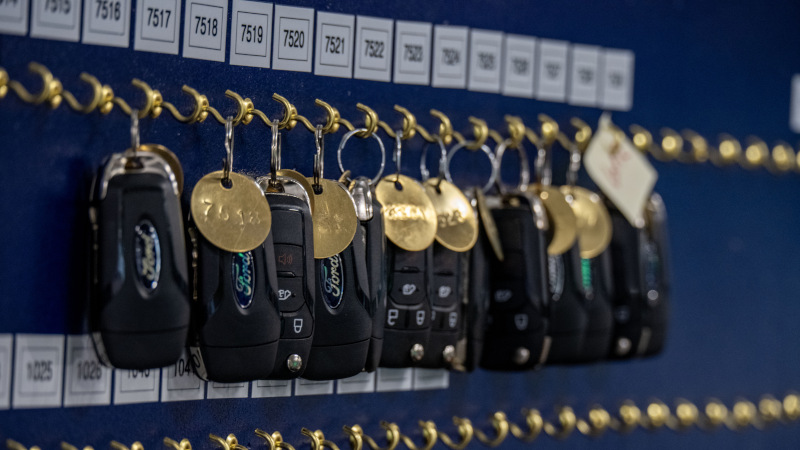
- Are keys left on an open board?
- Or is there a structured check-in/check-out process?
Uncontrolled access during business hours is a major red flag.
- Missing Key Procedures
- Is there a defined process when a key goes missing?
- Or is it handled reactively each time?
Insurers expect consistent and documented protocols, not improvisation.
What Insurance Auditors Look for On-Site
When insurers conduct a risk inspection or post-incident review, they are typically evaluating three core elements.
- Physical Security of Key Storage
Keys should be:
- Stored in a locked enclosure
- Protected from unauthorized access
- Not visible or accessible to the public
Industry guidance recommends secure cabinets or electronic systems to prevent theft and misuse. [marsh.com]
- Controlled Access
Auditors want to verify:
- Who has access to the keys
- How access is granted
- Whether access is restricted by role
The more controlled and individualized the access, the stronger the risk profile.
- A Verifiable Audit Trail
This is often the most critical factor.
In the event of a theft:
- Insurers will ask who last accessed the key
- The ability to produce a report can directly impact claims outcomes
Without a clear audit trail:
- Claims may be delayed
- Investigations become more complex
- Liability concerns increase
How Key Management Impacts Your Insurance Policy
While every policy is different, key controls can influence:
- Premium pricing
- Deductibles
- Policy exclusions
- Ease of renewal approval
Dealerships with strong controls are viewed as:
- Lower risk
- Better managed
- Easier to insure
Those without may face:
- Higher premiums
- Stricter policy terms
- Increased scrutiny during renewal
The Real Risk: Weak Key Control = Easier Theft
From a risk perspective, the logic is simple:
- A vehicle without a key is difficult to steal
- A vehicle with accessible keys is not
Loose key control practices — such as:
- Keys on desks
- Unlocked storage
- No tracking system
…create opportunities for both:
- External theft
- Internal misuse
Insurance claims often start with one simple question:
“Where were the keys?” [dealerrisk…rvices.com]
What This Means for Canadian Dealerships
The takeaway is clear:
Before your next renewal, you should be able to confidently answer:
- Where are all keys stored after hours?
- Who has access to them?
- Can you track every key movement?
- Do you have a documented process?
If the answer is unclear — now is the time to address it.
How to Strengthen Your Position Before Renewal
Start With the Basics
- Secure all keys in locked storage
- Implement a consistent sign-out process
- Assign accountability to staff
Then Assess Your Scale
For higher-volume dealerships:
- Manual processes often break down
- Audit gaps become inevitable
- Risk exposure increases
Consider Electronic Key Management
Electronic systems provide:
- Real-time tracking
- Individual user access
- Automatic audit trails
- Stronger compliance with insurer expectations
They offer the clearest, most defensible answer to every question insurers are now asking.
Final Thoughts: Be Ready Before They Ask
Insurer expectations are evolving — quickly.
What used to be acceptable dealership key storage (manual logs, shared access, open boards) is no longer sufficient in many cases.
The dealerships that get ahead of this:
- Reduce risk
- Improve operational efficiency
- Strengthen their negotiating position at renewal
Those who don’t may be forced to react under pressure later.